Just two years ago, space in Polish shelters and emergency hideouts was enough for less than 4% of the population. Today, Poland has a new civil defense law, detailed technical regulations for protective structures, the first nationwide funding program for civil protection, and major urban projects — such as Warsaw's "Underground Shield". In the sixth overview of the "European Shelters" series, we explore how our neighbor is building a defense system tailored to modern threats and what this means for the shelter market.
The Starting Point: An Honest Audit
In March 2024, Poland's Supreme Audit Office (NIK) released the results of an audit covering 2020–2023. According to inventory data from the State Fire Service (PSP) cited by NIK, places in protective structures were sufficient for less than 4% of the population — approximately 1.43 million people. The country had 1,903 shelters and 8,719 emergency hideouts. Basements, parking garages, and other places for temporary shelter were counted separately: their capacity would be enough for the entire population, but their level of protection is significantly lower.
During random inspections, NIK experts established that 17 out of 25 shelters (68%) and 10 out of 19 emergency hideouts failed to meet technical requirements. A significant portion of the stock had been built as far back as the 1950s and required modernization. The audit's findings became the catalyst for reform, and Poland tackled it systematically: from legislation to technical standards, funding, and concrete urban projects.
Legal Framework: From Legislation to Technical Regulations
The foundation of the reform was the Law on Population Protection and Civil Defense of December 5, 2024. Most of its provisions took effect on January 1, 2025, with specific provisions entering into force later.
Subsequently, the regulatory framework was built step by step. In the summer of 2025, decrees came into force regarding the designation of protective structures in public buildings and requirements for places for temporary shelter (MDS) — adapted premises used for short-term protection.
The key technical document is the Regulation of the Minister of the Interior and Administration of November 4, 2025, on technical conditions for protective structures, effective since November 28, 2025.
The regulation introduces resistance classes that determine which solutions can be applied:
- U-1 and U-2 — emergency hideouts protecting against shrapnel, small arms fire, and structural collapses (U-2 also attenuates radiation); overpressure for these is not standardized;
- U-3 — from 60 kPa;
- S-1 — shelter from 100 kPa; there is no requirement for underground placement;
- S-2 — from 200 kPa, strictly underground;
- S-3 — from 300 kPa, also strictly underground.
In terms of design pressure, Polish S-1 and S-2 match Finnish S1 and S2: 100 and 200 kPa. At the same time, the S-1 class involves more than just blast pressure: the shelter must be airtight, equipped with filtered ventilation, and protect against radiation and fire.
The regulation also defines accessibility limits: within city boundaries, a protective structure must be located no further than 500 meters from people's locations, and beyond city administrative borders — no further than 1 km. If a structure is only partially submerged, a soil layer of at least 0.7 m must be provided as an earthen embankment on top of the shelter.
The regulation explicitly allows four layout options: fully or partially submerged structures, built-in facilities, or standalone buildings. The latter option is vital for the market. Classes S-2 and S-3 are underground by definition, so a standalone above-ground module can serve as a class U shelter or an S-1 class shelter.
In addition, the regulation specifies requirements for entrances, ventilation, water supply, sewage, power supply, and fire safety. Among these is a rule reflecting modern warfare experience: outdoor entrances must be protected against drone strikes, for example, using steel mesh barriers.
The obligation to provide emergency hideouts in new multi-apartment residential and public buildings with underground levels has been effective since January 1, 2026 — for investment projects whose permit applications were submitted after December 31, 2025. This primarily concerns underground levels and parking garages that can be quickly adapted, rather than full-fledged airtight blast shelters. This phase is currently having the biggest impact on the real estate market.
In April 2026, amendments were made to the law, with most new rules entering into force on May 29. A new category emerged — shelter points (punkty schronienia), such as underground parking garages or tunnels. These are basic locations without detailed technical specifications: they are designated by the fire service, and property owners must grant public access during air raid alarms or air strike threats.
Funding: The First Program of This Scale
Parallel to the regulatory framework, Poland secured funding. In May 2025, Donald Tusk's government approved the Population Protection and Civil Defense Program for 2025–2026 — nearly 34 billion PLN (16.7 billion in 2025 and 17.2 billion in 2026), or approximately 8 billion EUR. The law guarantees at least 0.3% of GDP annually for these purposes. Most of the funds flow to local communities (gminas) through voivodes — for shelters, stockpiles, rescue equipment, warning systems, and training.
In June 2026, the ministry introduced a draft of the next program — allocating at least 105 billion PLN for 2027–2031. At the time of preparing this review, the document was undergoing approvals prior to Council of Ministers authorization. The new program envisions five-year investment planning for shelters, signaling long-term market demand.
Major Urban Projects: The Warsaw Metro Example
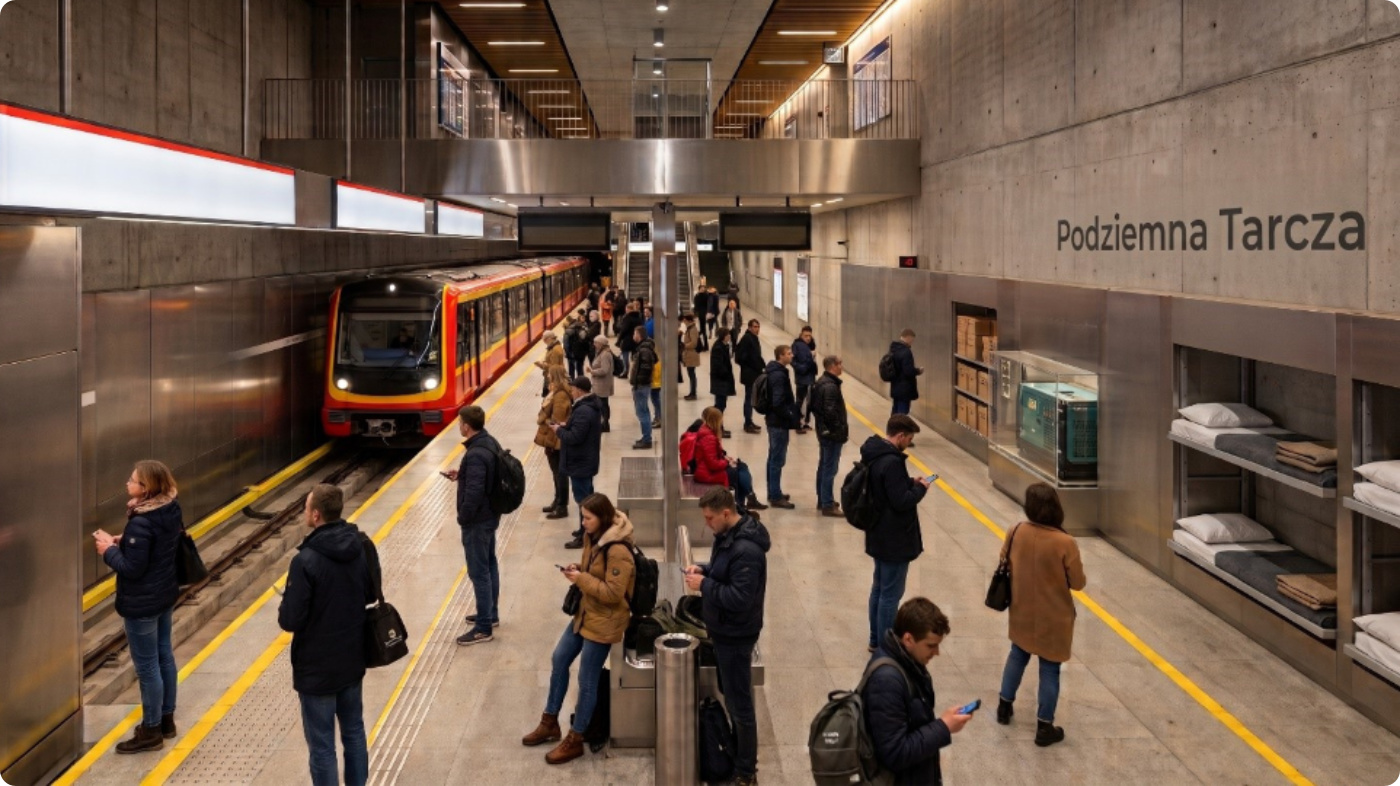
Cities are also taking action. On December 17, 2025, Warsaw Mayor Rafał Trzaskowski announced the "Underground Shield" project (Podziemna tarcza). In cooperation with the fire service, the city will adapt metro stations as shelter spaces for over 100,000 people, converting technical cavities into emergency supply depots stocked with water, cots, and blankets.
Warsaw is pursuing its goal systematically and realistically. During the 2024 audit, NIK and experts inspected two stations on the first line and one ventilation facility. The section from Kabaty to Wierzbno was originally engineered as a fallout shelter, but some equipment was never installed, preventing complete airtight sealing. This is why the metro is being adapted as a temporary shelter location: existing infrastructure enables rapid protection for tens of thousands of citizens without major new construction.
Kraków follows a similar strategy: the first metro line currently being planned by the city is being engineered from scratch with dual-use shelter functionality.
What Does This Mean for the Market?
The "Underground Shield" demonstrates how major cities seek the fastest methods to protect populations — primarily utilizing existing underground infrastructure.
At the same time, the metro primarily covers areas immediately adjacent to stations. New residential complexes, suburban schools, private sectors, and cities without metro systems require alternative solutions, while the 500-meter urban accessibility rule demands that shelters be located close to people.
Part of this demand will be met by new buildings featuring underground levels. Where underground levels are absent or where buildings already exist, the regulation allows standalone structures. Consequently, the market is expanding across several avenues: large urban underground facilities, adapted levels in new developments, and standalone modular shelters near schools, housing, and industrial sites. These solutions do not compete; they complement one another.
Modern Threats: Standards and Live Field Tests
The Polish regulation is a modern, detailed document. It standardizes blast wave pressure, protection against shrapnel, structural collapse, radiation, and fire, while requiring drone defense measures at entrances.
Furthermore, the regulation makes it possible to specify a design threat level for a specific facility — defining the type and mass of explosives at a specified distance from the structure. This is an additional requirement applied when a facility must withstand a specific threat, such as a nearby kamikaze drone detonation.
Ukraine's operational experience proves that this approach is practical. When a municipality, school, hospital, or enterprise chooses a solution, it is beneficial to know not only the structure's resistance class, but also how it withstands actual blast detonations.
BUNKEROK Experience: Live Field Testing as a Complement to Standards
BUNKEROK modular shelters were developed in wartime conditions and verified through full-scale live field tests.
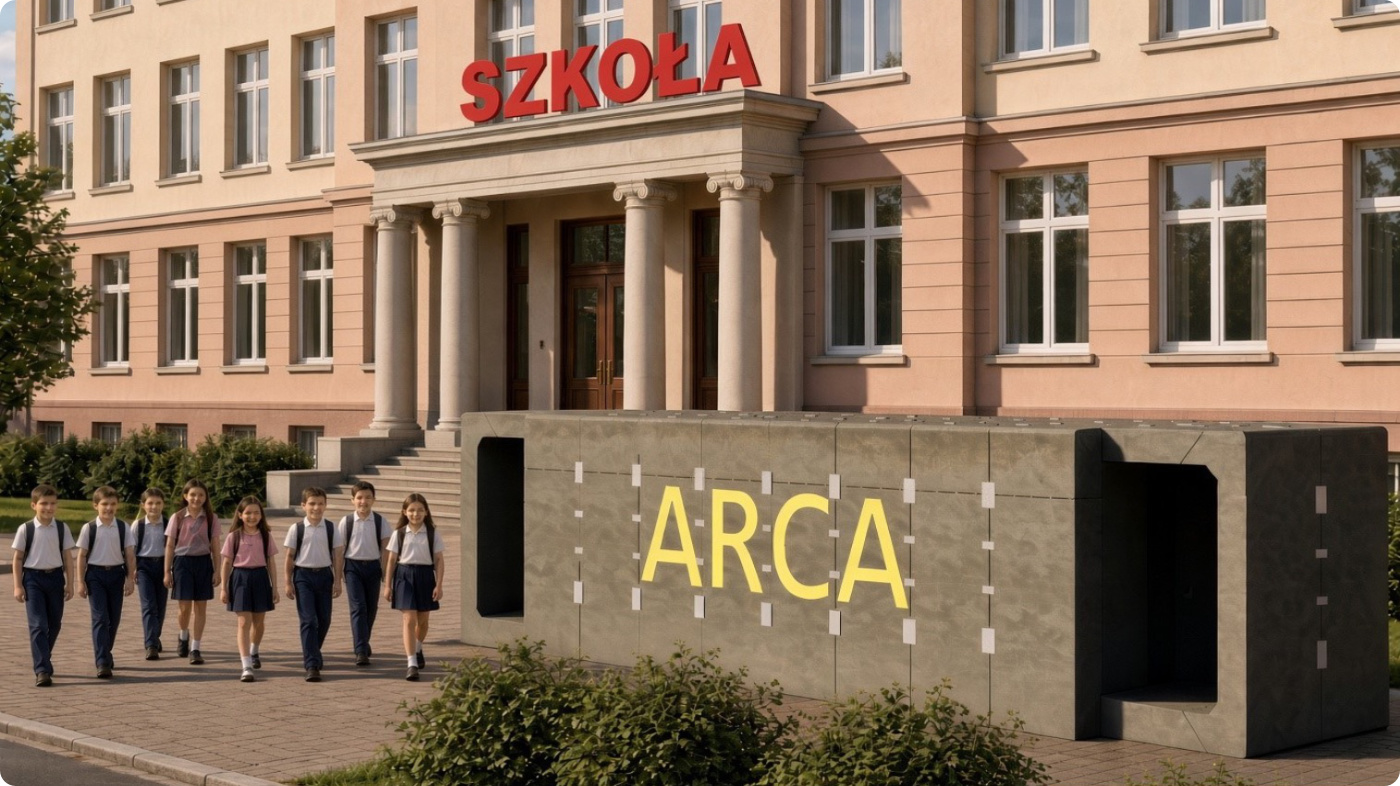
The BUNKEROK product lineup covers diverse deployment scenarios: from compact residential modules to high-capacity facilities for schools and public buildings. The ARCA module underwent live detonation testing with a 50 kg high-explosive fragmentation warhead from a Shahed-type UAV detonated 5 meters from the shelter; recorded peak pressures reached up to 1,300 kPa. The findings are documented in an official Test Protocol.
Such empirical data does not replace engineering design under Polish building codes. However, it helps clients, design engineers, and public authorities observe how a structure performs under real blast loads, allowing them to establish a justified design threat level where needed. Polish regulatory standards and Ukrainian field experience naturally complement each other: regulations provide a clear framework, while live testing provides practical data. We are open to collaboration with Polish communities, architects, and investors to build safer shelters together.
Sources
· Supreme Audit Office (NIK), "W schronie się nie schronisz" (March 13, 2024): PSP inventory data — 1,903 shelters and 8,719 emergency hideouts providing 1,428,369 spaces (under 4% of the population); 17 out of 25 audited shelters and 10 out of 19 hideouts failed technical requirements; Warsaw metro inspection findings.
https://www.nik.gov.pl/najnowsze-informacje-o-wynikach-kontroli/budowle-ochronne-miejsca-ukrycia.html
· Act of December 5, 2024 on Population Protection and Civil Defense, Dz.U. 2024 item 1907 (most rules effective January 1, 2025).
https://dziennikustaw.gov.pl/DU/2024/1907
· Regulation of the Minister of the Interior and Administration of November 4, 2025 on technical conditions for protective structures, Dz.U. 2025 item 1548 (effective November 28, 2025): classes U-1 to S-3, 500 m / 1 km rule, 0.7 m soil cover, drone entrance protection, design threat levels.
https://dziennikustaw.gov.pl/DU/2025/1548
· Prawo.pl, May 11, 2026: amendment to the Act of April 17, 2026 — shelter points, capacity calculation rules for temporary shelters.
https://www.prawo.pl/samorzad/zmiany-w-ustawie-o-ochronie-ludnosci-i-obronie-cywilnej-2026-r,535316.html
· National Headquarters of the State Fire Service (KG PSP), May 28, 2025: Council of Ministers approved the Population Protection and Civil Defense Program 2025–2026 — 16.7 billion PLN in 2025 and 17.2 billion PLN in 2026.
https://www.gov.pl/web/kgpsp/rzad-przyjal-program-ochrony-ludnosci-i-obrony-cywilnej-na-lata-2025-2026
· InfoSecurity24, June 24, 2026: MSWiA presented the 2027–2031 program proposal — at least 105 billion PLN.
https://infosecurity24.pl/wiadomosci/mswia-przedstawia-program-ochrony-ludnosci-i-obrony-cywilnej-na-stole-105-miliardow-zlotych
· TVN Warszawa, December 17, 2025: Rafał Trzaskowski announced the "Podziemna tarcza" project — adapting the metro as a shelter space for over 100,000 people.
https://tvn24.pl/tvnwarszawa/srodmiescie/warszawa-rafal-trzaskowski-rozpoczynamy-projekt-podziemna-tarcza-st8806594
· Rynek Infrastruktury, February 19, 2026: Krakow's first metro line planned from the outset with shelter functionality.
https://www.rynekinfrastruktury.pl/wiadomosci/miasto/krakow-metro-od-razu-bedzie-planowane-do-funkcji-schronu--98829.html
BUNKEROK is not just a shelter manufacturer.
We are shaping a new security norm where protecting human lives can no longer rely on compromises. BUNKEROK exists to turn life, business, and infrastructure SAFETY into the NEW STANDARD of the modern world.
We are open to partnerships, collaborations, and building a stronger, safer future together.
WEBSITE: bunker-ok.com.ua
INSTAGRAM: @bunkerok_ukraine
YOUTUBE: @bunker-ok
FACEBOOK: bunkerok.ukraine
LINKEDIN: bunkerok
Visit, subscribe, and share. Become part of a new safety culture. Every share contributes to knowledge that can save lives. Together, we shape a culture of responsibility, strength, and security for future generations.
JOIN US. SHARE. BUILD A FUTURE WHERE PROTECTION IS EVERYONE'S CONSCIOUS CHOICE.