Estonia, Latvia, and Lithuania are often described with a single word—the Baltics. But in the realm of civil defense, this is not one unified system, but three distinct experiments that began almost simultaneously. Following Russia’s full-scale invasion of Ukraine, all three countries began identifying basements, parking garages, and pedestrian underpasses, marking them on digital maps, updating building codes, and educating citizens on where to go when air raid sirens sound.
The reason is straightforward: here, a shelter must be part of daily life—located directly in one’s apartment building, school, office, or within a few minutes' walk. That is why the Baltic model begins not with constructing brand-new concrete bunkers, but with auditing existing infrastructure.
Why the Baltic States Cannot Wait for the "Ideal" System
Finland and Sweden inherited a vast legacy of Cold War bomb shelters. The Baltic states lacked such a pre-existing network. Therefore, after 2022, governments faced a practical question: what can be utilized immediately while new standards and capital construction projects are being developed?
The answer emerged in two tiers. The first tier involves rapidly identifying nearby underground or interior spaces capable of mitigating risks from shrapnel, flying glass, and blast waves. The second tier focuses on gradually upgrading selected sites into verified shelters equipped with proper access, ventilation, emergency exits, lighting, and designated management.
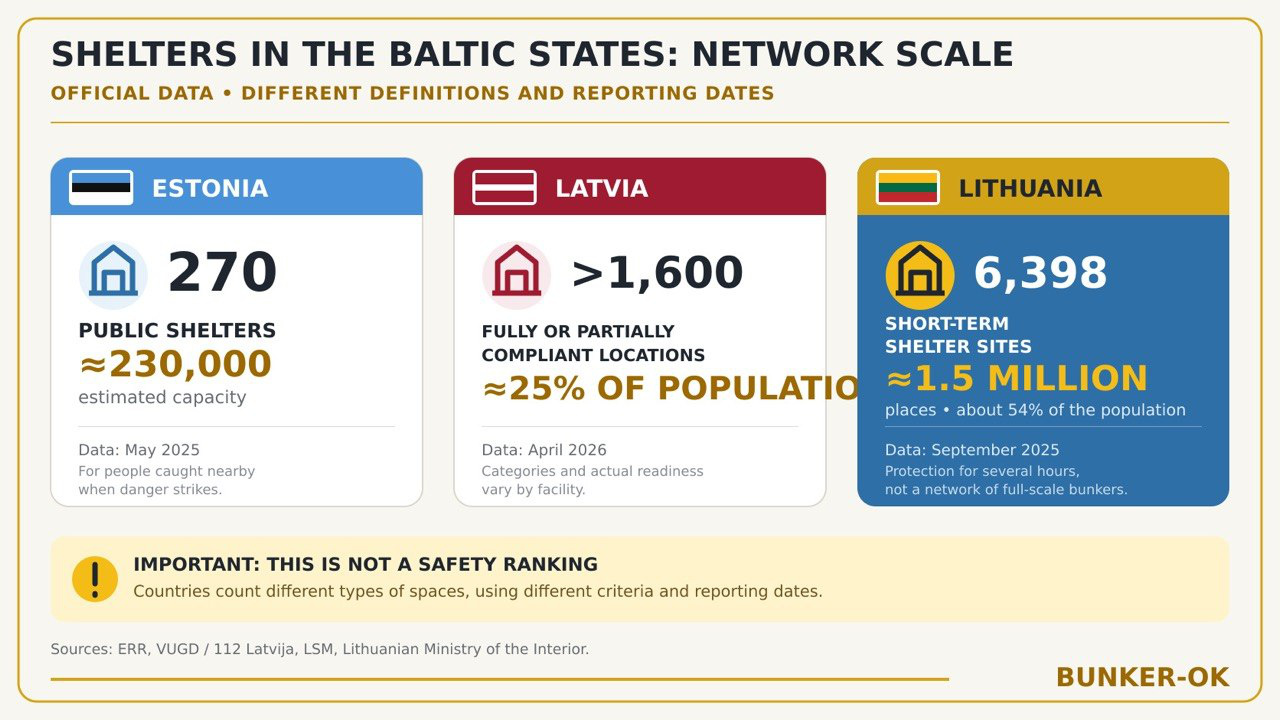
Consequently, directly comparing these figures across countries is inaccurate, as each nation counts and organizes its shelter network differently. The Lithuanian "priedanga" provides short-term protection for up to a few hours. The Latvian system categorizes structures into three distinct levels. The Estonian map highlights public shelters intended for individuals caught out in the open. A single address in each of these systems represents a different level of protection.
Estonia: From Basement Mapping to Mandatory Shelters in New Buildings
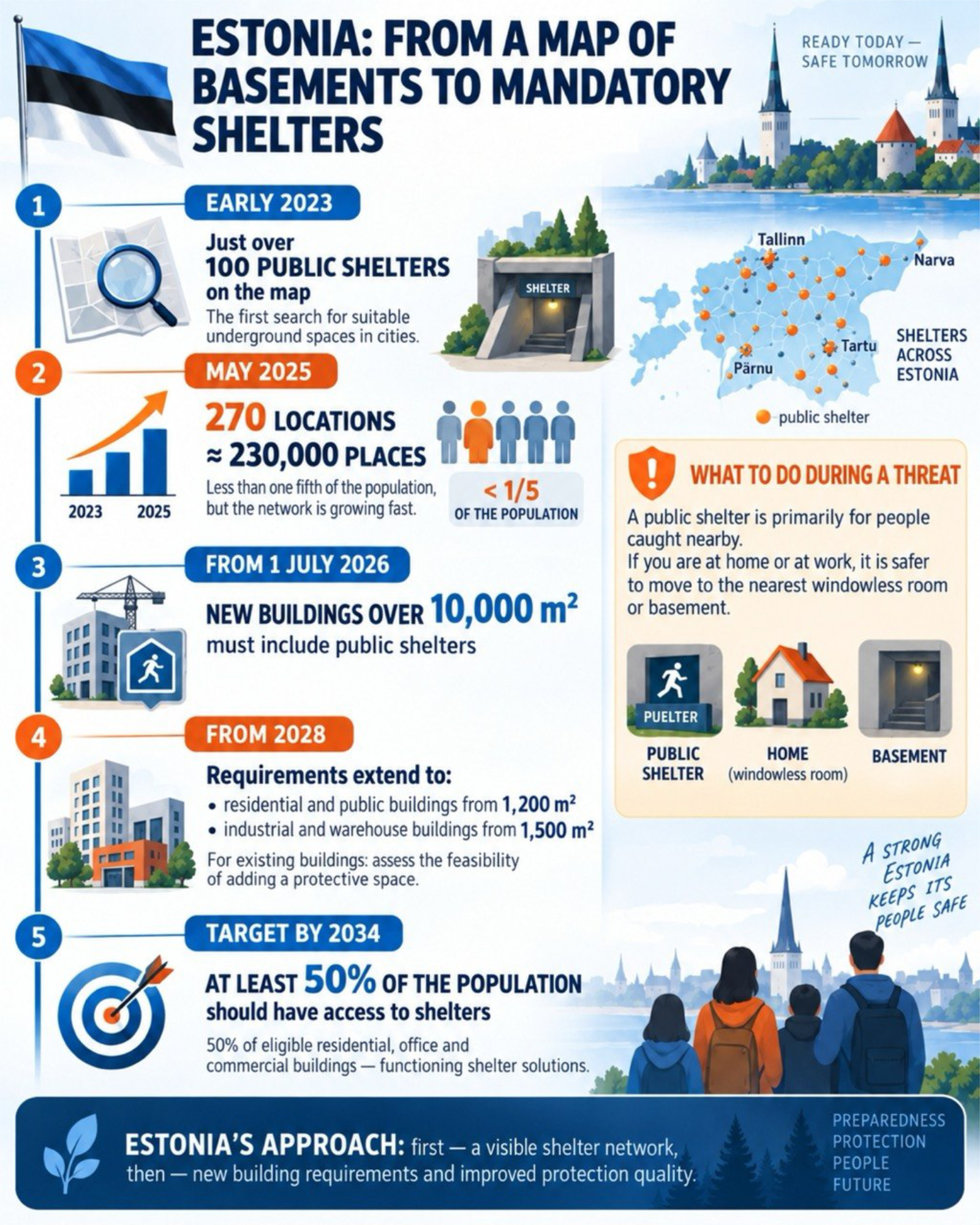
Estonia began with the fastest solution: identifying large underground spaces in urban areas. In early 2023, the national map listed just over a hundred public shelters. By May 2025, the network had expanded to 270 locations with a capacity of approximately 230,000 places. While this covers less than a fifth of the country's population, the progress is clear: the state first establishes an accessible network and then works to upgrade its quality.
The Estonian Rescue Board emphasizes an important distinction: public shelters are primarily intended for individuals caught nearby when an alert sounds. If someone is already at home or in their workplace, it is safer to move to an internal windowless room or basement rather than travel across the city to a mapped public shelter. This approach minimizes hazardous movement during an active alert.
The next phase focuses on building regulations. As of July 1, 2026, Estonia mandated public shelter integration in new buildings exceeding 10,000 square meters. Beginning in 2028, these requirements will extend to various residential and commercial buildings larger than 1,200 square meters, as well as major industrial and storage facilities. Owners of existing structures are urged to assess the feasibility of adding protective spaces.
The long-term objective goes beyond counting site addresses. By 2034, the country aims for at least half of the population to have access to a shelter, and for 50% of relevant residential, office, and commercial buildings to feature functional protection solutions.
Latvia: Three Categories Instead of a Single Term "Shelter"
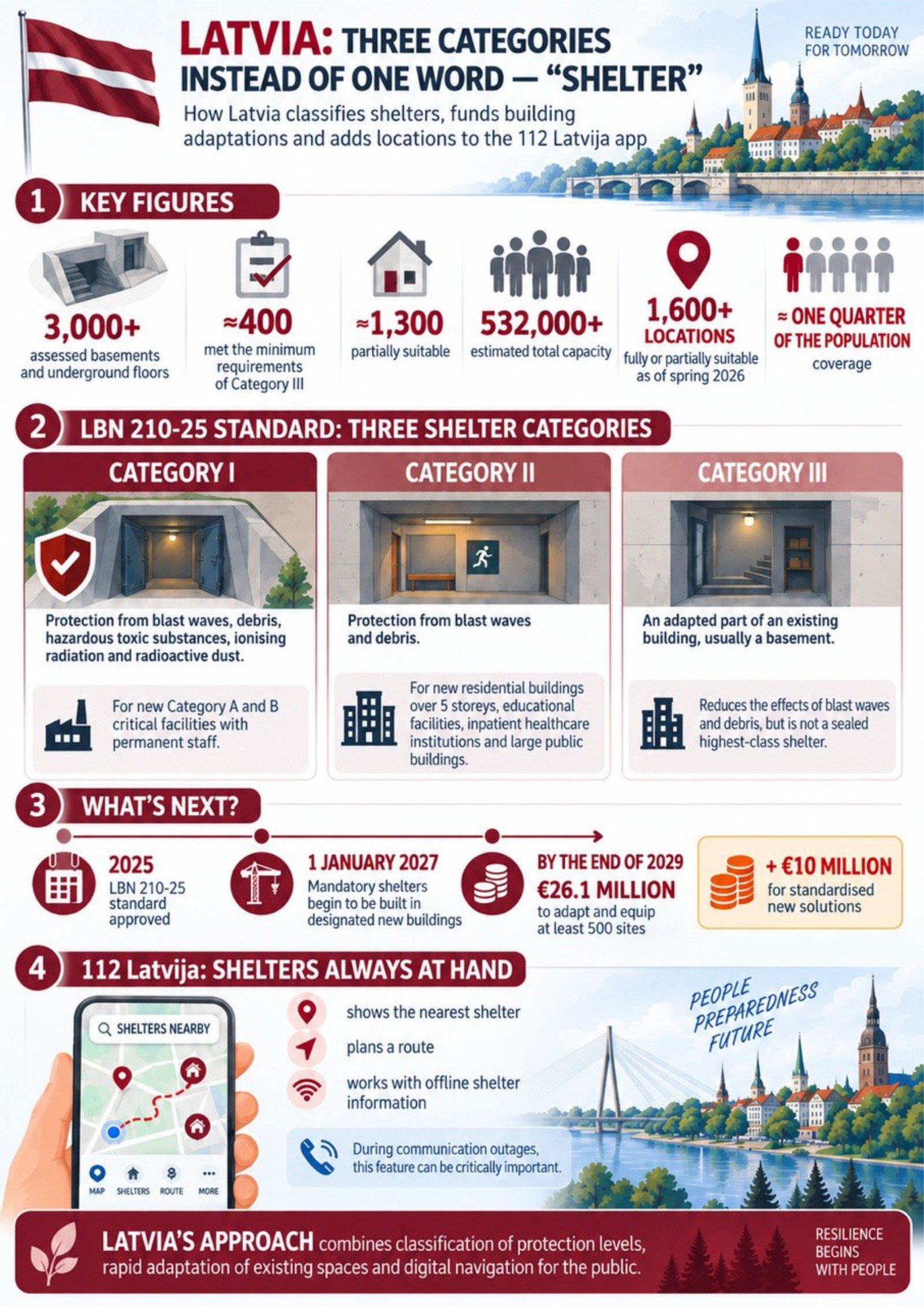
Latvia opted for a clear classification system. After inspecting over 3,000 basements and underground levels in state and municipal buildings, rescue authorities determined that nearly 400 met the minimum requirements for Category III, while approximately 1,300 partially met the criteria. Their combined estimated capacity exceeded 532,000 people. By spring 2026, officials reported over 1,600 fully or partially suitable locations—enough to accommodate roughly a quarter of the population.
The key strength of the Latvian approach is its clear differentiation of protection levels. In 2025, the country adopted the LBN 210-25 standard, establishing three distinct shelter categories.
Mandatory shelter construction in designated new developments will take effect on January 1, 2027. Concurrently, Latvia is funding immediate retrofits: over €26 million is allocated to adapt and equip at least 500 existing sites by the end of 2029, with an additional €10 million designated for standardized new solutions.
Shelter locations are integrated into the 112 Latvija app. The application not only directs users to the nearest shelter and calculates route directions, but also stores shelter data for offline access. This offline capability is critical during mobile network disruptions when live maps may fail to load.
Lithuania: The Largest Shelter Network in the Baltics—With an Important Caveat…
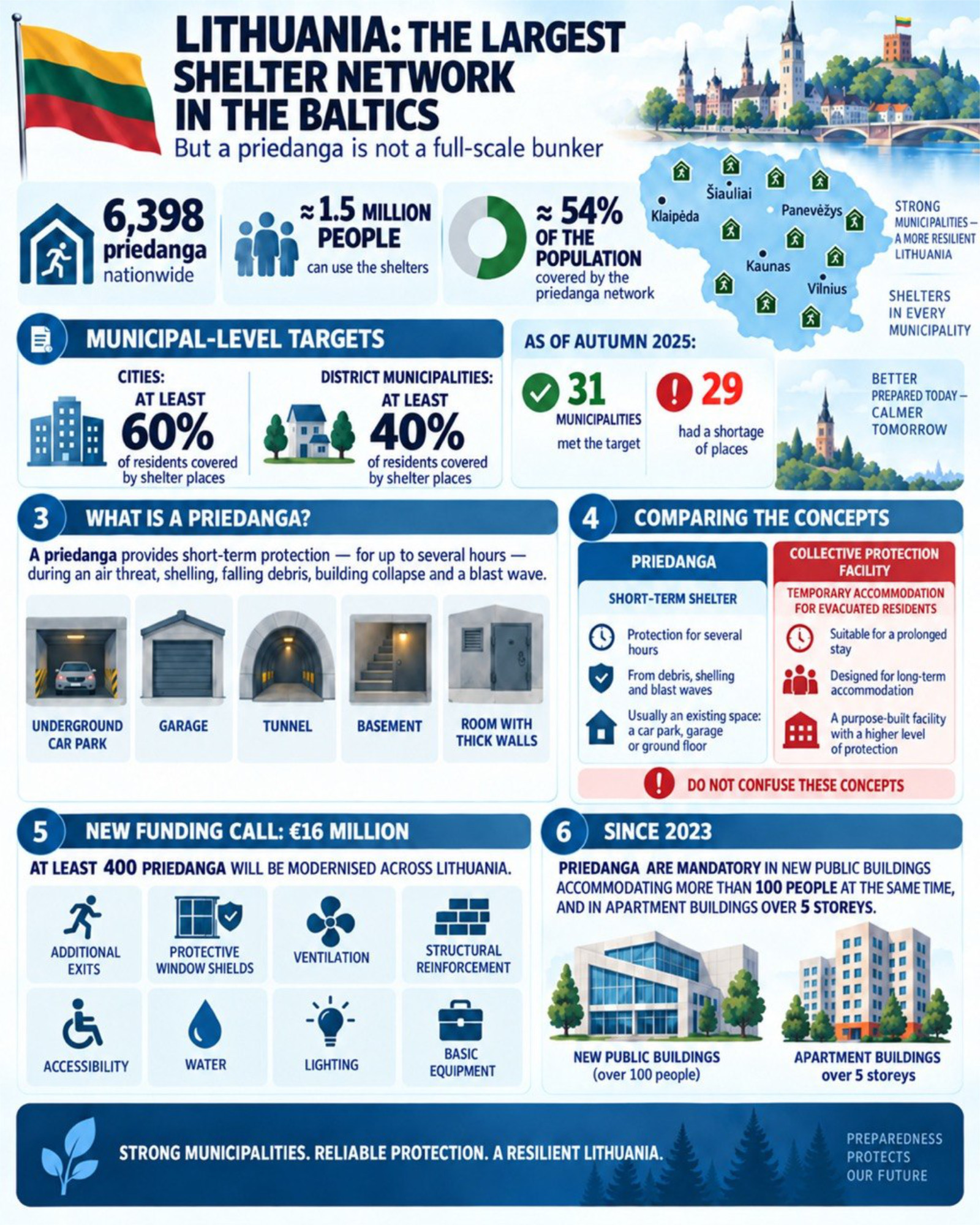
Lithuania reports the highest capacity numbers in the region: 6,398 "priedanga" facilities catering to approximately 1.5 million people, or roughly 54% of its population. These statistics were released by the Ministry of the Interior in September 2025. At that time, 31 municipalities had met national coverage quotas, while 29 still faced space deficits. Target guidelines require urban centers to accommodate at least 60% of residents, and regional municipalities to cover at least 40%.
However, 6,398 does not represent the count of fully equipped bunkers. The official LT72 civil safety portal clarifies: a priedanga is intended for short-term protection (up to a few hours) during air raids, shelling, shrapnel exposure, structural debris falls, and blast waves. It can be an underground parking lot, garage, tunnel, basement, or another space with sturdy walls and ceilings.
The Lithuanian system distinguishes a priedanga from a collective protection structure. Collective protection facilities are intended for temporary accommodation during broader emergency evacuations and include sites like schools, sports complexes, or cultural centers. Conflating these two concepts poses a risk: an evacuation facility does not automatically offer explosion protection, while a short-term priedanga is not engineered for extended autonomous stays.
Following an initial funding round, the state launched a second €16 million call for projects to modernize at least 400 priedanga locations. Key improvements include adding secondary emergency exits, window blast shields, mechanical ventilation, structural reinforcements, accessibility features for individuals with reduced mobility, water supplies, emergency lighting, and basic equipment.
Requirements to incorporate civil defense into building designs have been active since 2023: a priedanga must be included in new public buildings designed for over 100 occupants simultaneously, as well as in residential buildings exceeding five stories.
What Solutions the Baltic States Need Today
The next phase will focus less on adding new map pins and more on engineering execution. For suitable underground areas, this requires structural modernization and reinforcement, blast doors, ventilation systems, backup power, communications, clear signage, and routine maintenance protocols. For schools, hospitals, commercial enterprises, and critical infrastructure, a basic basement is often insufficient.
Where retrofitting an existing building is technically unfeasible, ARCA modular shelters, mobile protective structures, private shelters, or site-specific custom engineering solutions offer viable alternatives. Selection should be driven by specific threat scenarios, occupancy demands, autonomy requirements, and local building codes rather than product titles alone.
Here, Ukrainian real-world experience offers valuable insights for the Baltic nations. While it does not replace local Estonian, Latvian, or Lithuanian building codes, it demonstrates how entrances, ventilation systems, electrical grids, and communications perform during actual missile and drone strikes. BUNKEROK integrates these operational lessons directly into the CPS – Civil Protection Standard, combining structural engineering analysis, load testing, ballistics, and field blast trials.
The Baltic states do not rely solely on massive individual bunkers. They combine multiple tiers of protection: nearby safe rooms, retrofitted basements, public shelters, new protective structures, digital mapping, and early warning networks. However, the ultimate effectiveness of this system depends not on the volume of app listings, but on whether a shelter remains accessible, operational, and ready to protect lives the moment a threat arises.
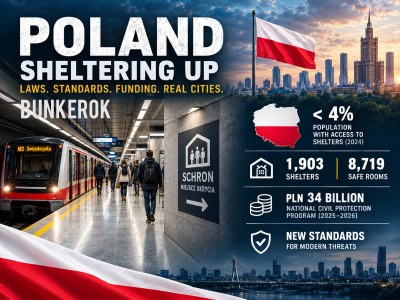
The next overview will focus on Poland—a nation also overhaul its civil defense infrastructure, updating legislation, and striking a balance between widespread short-term protection sites and full-scale protective shelters.
Data Note: Figures reflect the latest verified public data available at the time of publication.
Sources
Estonian Rescue Board: Public shelters
Government Office of Estonia: Crisis preparedness – Estonia’s activities in recent years
ERR: Estonia lagging behind other countries in the region on bomb shelter facilities
Estonian Chamber of Commerce and Industry: Soon shelters and shelter areas will need to be built
ERR: Estonia to introduce emergency shelter construction regulations
Latvia Ministry of Economics: A shelter construction standard has been developed
EU Funds Latvia: Latvia accelerates shelter network expansion and standardized solutions
LSM: Shelter situation in Latvia still not great
Lithuania LT72: Collective protection structures, priedanga and basements
Lithuania Ministry of the Interior: Second call for municipalities to modernize priedanga
Lithuania Ministry of Environment: Requirements for priedanga in new buildings
Useful Links
→ BUNKEROK Shelter Modernization and Reinforcement
→ How the CPS Civil Protection Standard Was Created
→ "Peace is No More": How Sweden Is Rearming with Shelters
→ European Shelter Market Analysis
BUNKEROK is not just a shelter manufacturer.
We are shaping a new security norm where protecting human lives can no longer rely on compromises. BUNKEROK exists to turn life, business, and infrastructure SAFETY into the NEW STANDARD of the modern world.
We are open to partnerships, collaborations, and building a stronger, safer future together.
WEBSITE: bunker-ok.com.ua
INSTAGRAM: @bunkerok_ukraine
YOUTUBE: @bunker-ok
FACEBOOK: bunkerok.ukraine
LINKEDIN: bunkerok
Visit, subscribe, and share. Become part of a new safety culture. Every share contributes to knowledge that can save lives. Together, we shape a culture of responsibility, strength, and security for future generations.
JOIN US. SHARE. BUILD A FUTURE WHERE PROTECTION IS EVERYONE'S CONSCIOUS CHOICE.