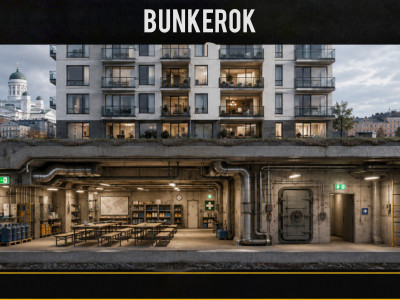
If Finland’s 85% coverage seems like a high standard, Switzerland completely redefines the concept of civil defense: it is the only country in the world where there are physically more shelter spaces than actual residents. How does this phenomenal surplus work, why have the Swiss built a system of total protection for decades, and what do the lessons of the last century have to do with it?

How Switzerland Became the World Record Holder
On May 24, 1959, 62.3% of Swiss citizens voted in a referendum to include a civil defense provision in the country's Federal Constitution. It was this decision, made under the impression of carpet bombings during World War II and atomic strikes on Japan, that laid the foundation for a system that today has no parallels in the world.
The symbol of this era became the Sonnenberg Tunnel in Lucerne—the world's largest individual bomb shelter, opened in 1976 and designed for 20,000 people.
According to the Swiss Federal Office for Civil Protection (FOCP / BABS), as of the end of 2022, the country had about 9.3 million shelter spaces in nearly 370,000 shelters—both private and public—for a population of around 8.7 million people. This represents a coverage rate of 107%. No other country in the world boasts such a figure.
The Phenomenon of the Swiss Surplus
This colossal figure is a direct result of an unprecedented state policy established back during the Cold War. Starting in 1963, when the first decrees to the federal law on civil defense came into force, the legislation mandated equipping a protective room in every newly constructed residential building, while those who could not do so had to pay a special contribution to finance public shelters.
In 2012, the requirement was somewhat relaxed: the mandatory construction of a personal shelter now applies to buildings with 38 or more apartments; in other cases, owners pay a compensatory contribution. Thanks to this concept of "a shelter for everyone," the country achieved a unique surplus—there are physically more shelter spaces created than there are citizens.
Behind the Scenes of Ideal Statistics
At the same time, maintaining such a massive infrastructure is an ongoing process. Changing demographic trends, active urbanization, and the natural aging of the earliest protective structures prompt the state to review its safety approaches.
Despite the overall nationwide surplus of places, the level of shelter provision varies significantly among cantons. In five of them, coverage is currently below 100%, and noticeable local gaps remain in the historical and business centers of major cities. This is acknowledged by the Federal Office for Civil Protection (BABS) itself in its official materials. The main reason for such disparities is the dense development of metropolises, where it is technically difficult to equip new bunkers, as well as rapid population growth in certain urban agglomerations.
Swiss Shelters Are Aging: 700,000 Spaces at Risk
This issue of local space deficits faces a new challenge—a massive transition period that the Swiss civil defense system is currently undergoing. The fact is that the country is forced to decommission small private shelters (with a capacity of up to 7 people). This involves a colossal volume: about 100,000 facilities with a combined capacity for 700,000 people, as reported by BABS representative Andreas Bucher.
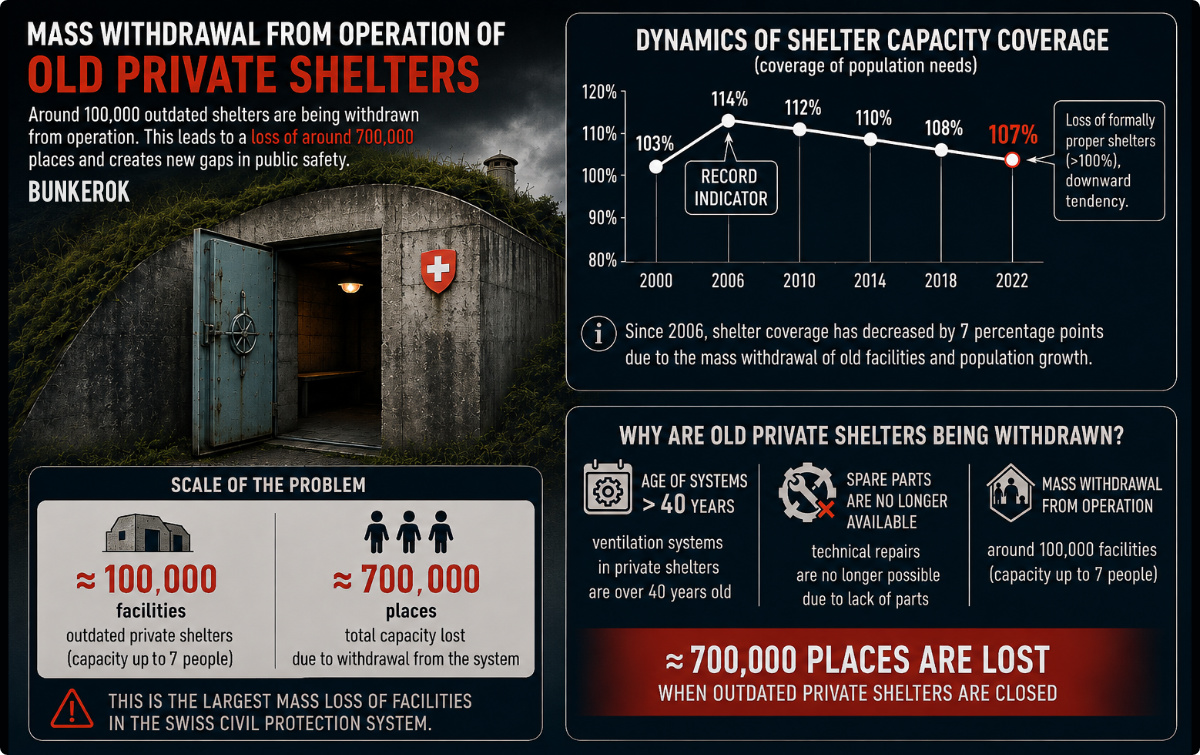
The reason for the liquidation is purely technical: their ventilation systems, which are over 40 years old, are hopelessly outdated, and spare parts for their repair are no longer manufactured. It is precisely due to this mass retirement of old facilities against the backdrop of population growth that the country's overall coverage indicator has gradually decreased: while in 2006 coverage reached a record 114%, by the end of 2022 it had contracted to 107%.
And although on a nationwide scale the figure formally remains above 100%, closing such local bunkers in specific residential buildings creates noticeable "blind spots" on the safety map: spaces exist in general statistics, but residents of specific neighborhoods lose protection directly near their homes.
It is no coincidence that after 2022 the Swiss government returned to the topic of shelter modernization as a priority—the reassessment of global threats, including the war in Ukraine, prompted a review of the condition of infrastructure built over decades for a threat of a completely different scale.
Scale Takes Years, Speed Is a Choice: Innovative Solutions Based on Ukrainian Experience
The Swiss model has proven the main point: achieving 100% population coverage is possible. However, this is a journey spanning decades, requiring constant state investment, strict regulation of every building, and colossal costs for mass modernization. Countries facing new security challenges today simply do not have this time resource at their disposal.
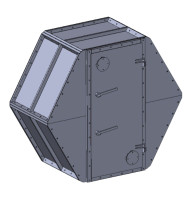
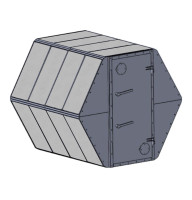
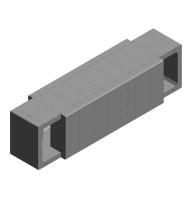
This is precisely the demand that BUNKEROK responds to. Our above-ground and underground modular shelters are created as a practical alternative to classic capital shelters, taking into account current modern threats. Unlike stationary facilities tied to large-scale construction, mobile modular solutions allow covering an acute deficit of protective spaces for communities, enterprises, or infrastructure within months, rather than decades.
According to BUNKEROK's estimate, the installation of a reinforced concrete modular shelter takes from 48 hours for compact solutions to 2-3 weeks for large-scale projects (such as schools, hospitals, or infrastructure facilities).
Our main advantage is rapid protection against modern threats. We have already conducted field blast testing with a high-explosive fragmentation warhead of a Shahed-type unmanned aerial vehicle weighing almost 50 kg (link to the test: https://www.youtube.com/watch?v=ykurf5J99b4) and are preparing for new tests with warhead weights up to 150 kg.
The security situation in Ukraine has taught us high engineering calculation standards, fast production, and rapid installation. We manufacture both stationary and mobile shelters with protection ratings of 800–1300 kPa—these are shelters delivered ready-made that can be relocated between sites without losing their protective properties.
Every shelter from BUNKEROK (https://bunker-ok.com.ua/) provides reliable protection for people without requiring complex and exhausting construction cycles.
We continue to study European experience: next, we will analyze in detail how the civil protection system is built in Germany.
Read more about:
→ The Shelter Market in Europe 2026: How Ukrainian Blast Testing Experience Is Changing Safety Standards (https://bunker-ok.com.ua/blog-ua/rynok-ukryttiv-u-yevropi-2026)
→ How Sweden Is Rearming with Shelters (https://bunker-ok.com.ua/blog-ua/myru-bilshe-nemaie-yak-shvetsiia-pereozbroiuietsia-skhovyshchamy)
→ Shelters in Finland: Will 50,000 Shelters Be Enough for Everyone? (https://bunker-ok.com.ua/blog-ua/ukryttia-u-finliandii-chy-vystachyt-50-500-skhovyshch-dlia-vsikh)
Sources
1. 9.3 million shelter spaces in ≈ 370,000 shelters, population ≈ 8.7 million, 107% coverage (end of 2022) https://www.swissinfo.ch/eng/business/switzerland-sets-gold-standard-for-designing-bunkers/48604892 (data from the Federal Office for Civil Protection BABS)
2. Referendum on May 24, 1959 — 62.3% "yes" https://www.admin.ch/ch/d/pore/va/19590524/index.html
3. Sonnenberg Tunnel in Lucerne — opened in 1976, designed for 20,000 people https://en.wikipedia.org/wiki/Sonnenberg_Tunnel
4. Obligation to build shelters since 1963, relaxation of requirements in 2012 https://www.thelocal.ch/20111201/1924
5. Decommissioning of small private shelters (statement by Andreas Bucher, BABS) https://www.swissinfo.ch/eng/business/switzerland-sets-gold-standard-for-designing-bunkers/48604892
6. 114% coverage in 2006 https://www.swissinfo.ch/eng/culture/bunkers-for-all/995134
Useful links
→ The Shelter Market in Europe 2026: How Ukrainian Blast Testing Experience Is Changing Safety Standards (https://bunker-ok.com.ua/blog-ua/rynok-ukryttiv-u-yevropi-2026)
→ How Sweden Is Rearming with Shelters (https://bunker-ok.com.ua/blog-ua/myru-bilshe-nemaie-yak-shvetsiia-pereozbroiuietsia-skhovyshchamy)
→ Shelters in Finland: Will 50,000 Shelters Be Enough for Everyone? (https://bunker-ok.com.ua/blog-ua/ukryttia-u-finliandii-chy-vystachyt-50-500-skhovyshch-dlia-vsikh)
BUNKEROK is not just a shelter manufacturer.
We define a new norm of safety where protecting life can no longer rely on compromises. BUNKEROK exists to transform the SAFETY of people, businesses, and infrastructure into the NEW STANDARD of the modern world.
We are open to partnerships, collaborations, and co-creating a stronger, safer future.
WEBSITE: bunker-ok.com.ua
INSTAGRAM: @bunkerok_ukraine
YOUTUBE: @bunker-ok
FACEBOOK: bunkerok.ukraine
LINKEDIN: bunkerok
Visit, subscribe, share. Become part of a new culture of safety in Ukraine. Every share is a contribution to knowledge that can save lives. Together, we shape a culture of responsibility, strength, and security for generations to come.
JOIN US. SHARE. BUILD A FUTURE WHERE PROTECTION IS EVERYONE'S CONSCIOUS CHOICE.