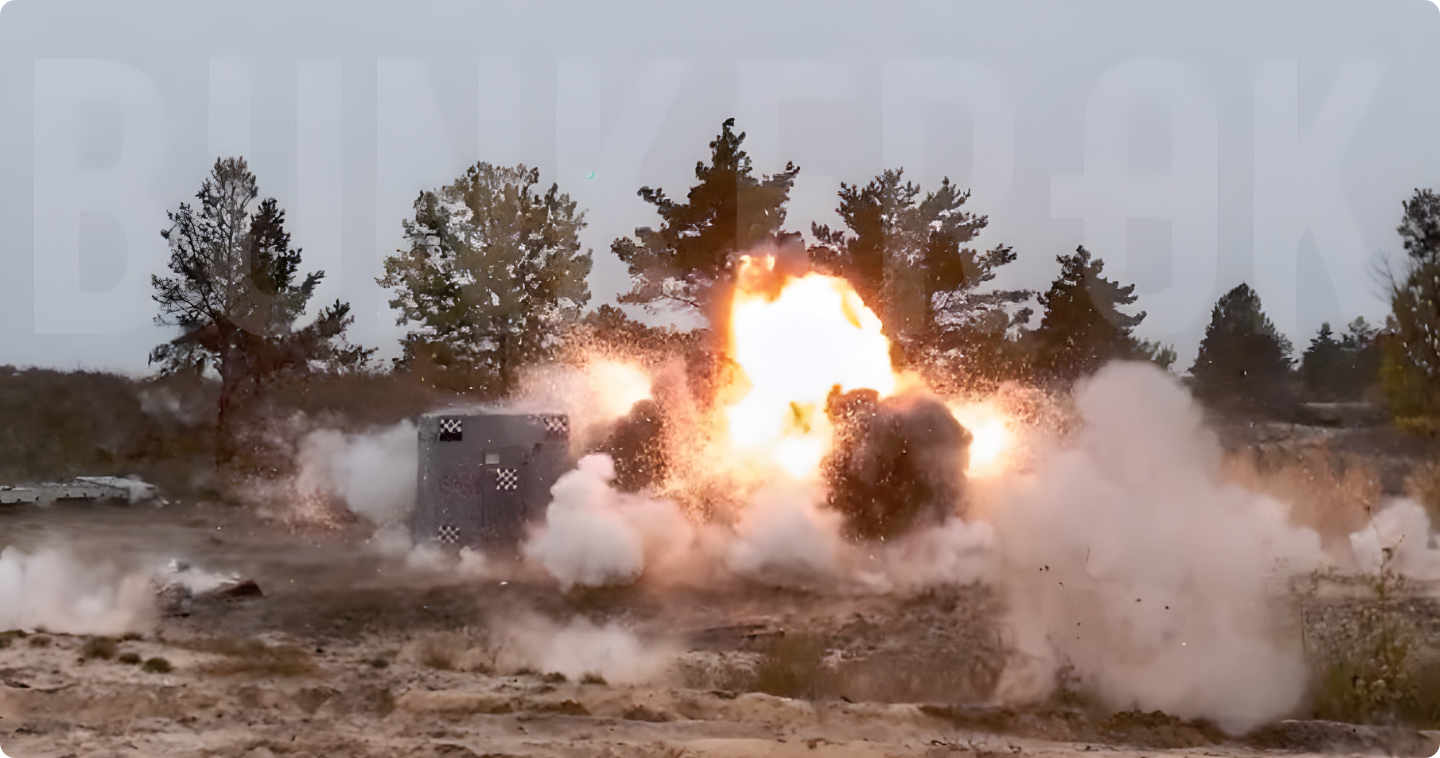
You are choosing a shelter. The seller says: "withstands 100 kPa." What does this number actually mean? And will such a shelter protect against a Shahed-136 UAV, which weighs almost 50 kg? Let's look at the facts.
The indicator of 100 kPa of blast wave overpressure is one of the most common characteristics of shelters on the Ukrainian market. It describes exclusively the impact of the blast wave.
A real explosion also involves shrapnel, the speed of its scattering, incendiary components, and local structural damage.
None of these factors are taken into account in the 100 kPa indicator.
What 100 kPa Actually Means According to DSTU 9329:2025
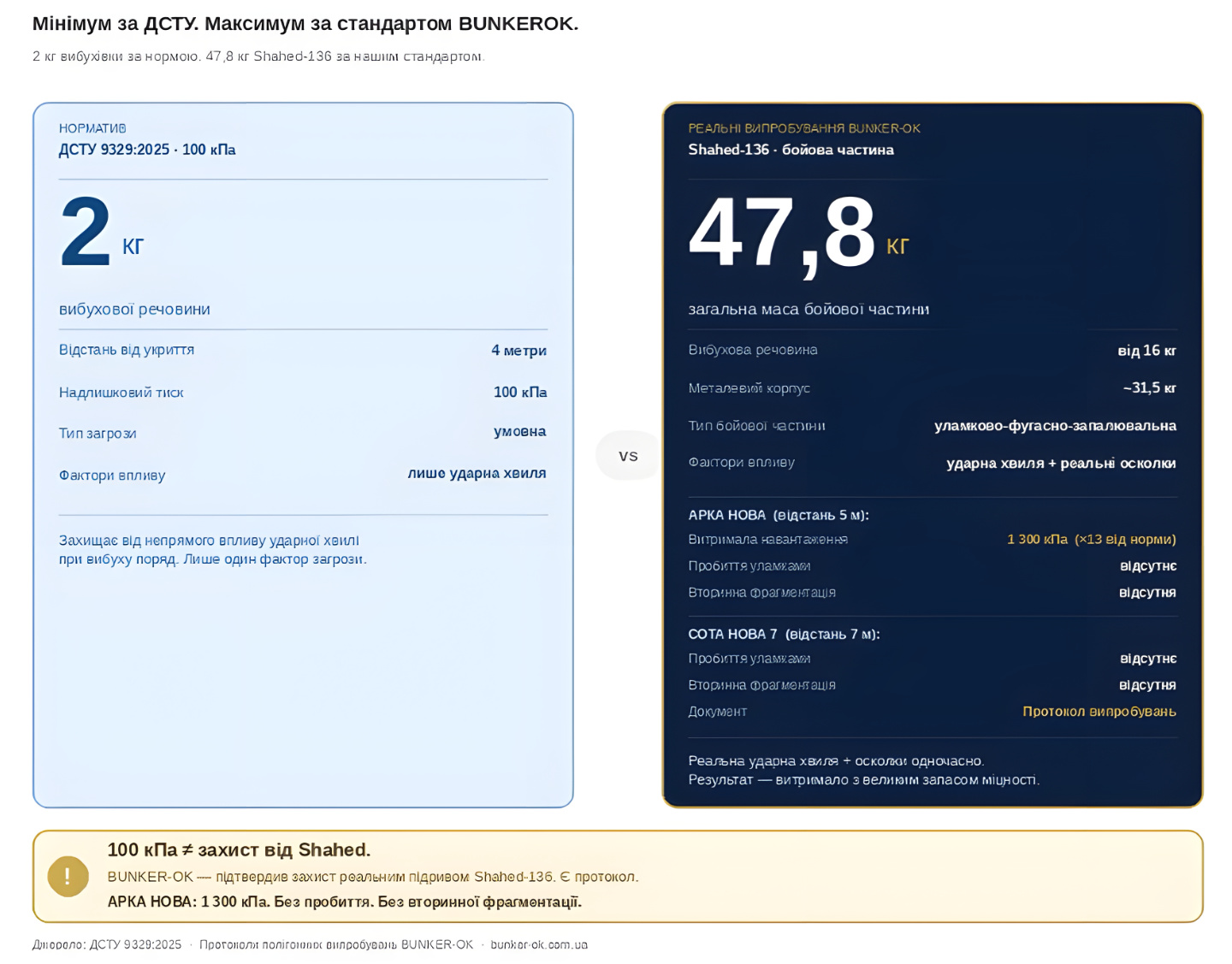
According to DSTU 9329:2025, a load of 100 kPa is accepted as the equivalent of the explosion of 2 kg of explosives at a distance of 4 meters from the structure.
The DSTU standard is focused on protection against small shrapnel and blast waves under conditions of indirect hits — and this is honestly stated in the standard itself.
To understand the scale: 2 kg of explosives is a hazard level typical for a close-range explosion of a small-caliber munition, but not for a heavy strike UAV.
For comparison, the warhead of a Shahed-136 strike UAV has:
- 47.8 kg – total mass;
- from 16 kg - mass of explosives;
- 31.5 kg - mass of the metal casing;
- high-explosive fragmentation incendiary - warhead type.
That 31.5 kg of metal casing is not just dead weight. Upon detonation or the crash of a downed Shahed, this metal turns into shrapnel scattering at speeds starting from 800 m/s. The blast wave within a 5-meter zone of a Shahed explosion reaches over 1,300 kPa — 13 times higher than the baseline DSTU indicator. Even a downed Shahed that crashes without detonating represents dozens of kilograms of metal falling at high velocity.
Therefore, for shelters designed to withstand the real threats of 2026, 100 kPa is just a baseline starting point, not the final specification.
The BUNKER-OK Approach: Real Threats Instead of Regulatory Minimums
According to 2026 statistics, the main threat comes from Shaheds. Since the beginning of the year, Russia has launched over 31,000 means of destruction at Ukraine, 97% of which are UAVs. Thanks to air defense operations, almost 95% of Shaheds are shot down — but they turn into debris that falls on houses, yards, and roads. This very debris constitutes the main daily threat to the civilian population.
Read more: "97 vs 3: Why UAV debris has become the main threat to civilians"
BUNKER-OK took a different path: validating strength not just through calculations, but through real-world detonation testing.
The ARKA NOVA and Sota Nova 7 shelters underwent proving ground testing with an actual 47.8 kg Shahed-136 warhead — at a distance of 5 m and 7 m from the structure, respectively.
The Result: the structures withstood the blast wave with a significant margin, confirming resistance to shrapnel and the absence of secondary fragmentation inside. The recorded load reached up to 1,300 kPa, which is 13 times higher than the baseline level of 100 kPa.
Would you wear a bulletproof vest that no one has tested?
The same logic applies to shelters. Demand a test report!
Useful Links
→ Buy a shelter with certified protection against Shaheds: https://bunker-ok.com.ua/arca-category-ua
→ Shahed-136 testing video: https://www.youtube.com/watch?v=ykurf5J99b4&t
→ Other articles by BUNKER-OK: https://bunker-ok.com.ua/blog-ua
→ Be the first to read — subscribe to the BUNKER-OK Telegram channel: @bunkerok_safe_with_us